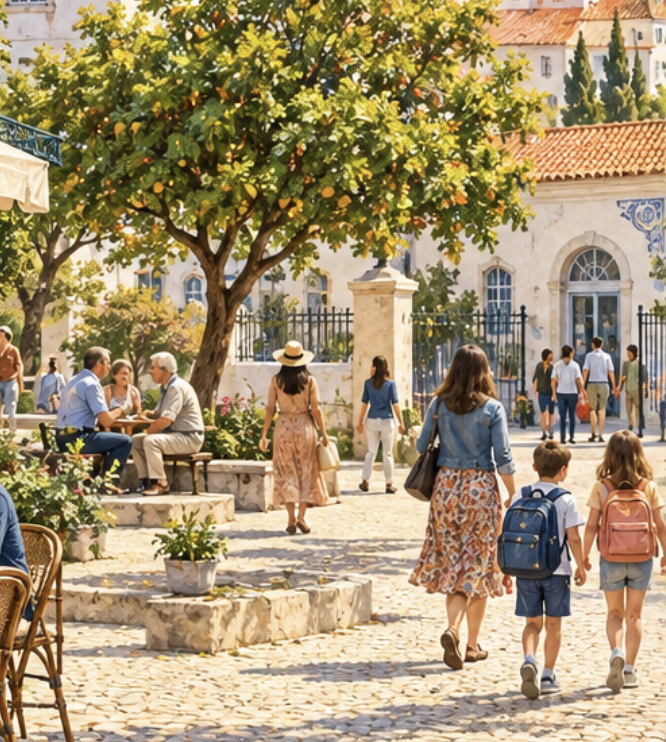
Moving to Portugal gives you a new address, and maybe freedom and peace of mind. But, feeling at home takes a bit more: familiar faces, shared routines, and people who notice when you have been away.

That part of the Portuguese lifestyle is easy to overlook when planning a move. We research housing, visas, taxes, and health care. Yet the quality of everyday life also depends on whether we have someone to greet at the café, a neighbor we can ask for help, and a place where we feel comfortable just showing up.
For newcomers, learning some Portuguese, approaching people with respect, and bringing a little humility can make a considerable difference. Connection grows through participation—and often begins with a simple bom dia.
The table is a place to connect
Dining out in Portugal can be an introduction to the community around you. And, the Portuguese love to dine out.
A neighborhood eatery offers more than a simple menu. Visit regularly and you may begin to recognize the lunchtime customers, learn the owner’s name, and understand which dishes appear on particular days. A café can become a familiar stopping point between errands, somewhere to exchange greetings and gradually move beyond ordering coffee. It is the center of local life.
Turismo de Portugal often describes the table as a focal point for socializing and sharing. That is a useful way to approach eating here: leave room for conversation as well as the meal. Meals can take up to 2 hours, no one clears plate unless everyone is done, and the check only comes when you ask for it.
And you can try the local specialties: Ask what is in season. Learn how to order what you enjoy. Dietary needs are worth explaining clearly and politely, and curiosity can help you discover dishes you might otherwise pass over. Have an opne mind.
You do not need an elaborate restaurant budget to participate. A coffee, a bowl of soup, or an occasional neighborhood lunch can help establish a routine. Familiarity comes from returning.
Look for the people behind the festivals
Portugal’s community life extends into musical societies, sports clubs, choirs, cultural associations, volunteer groups, and neighborhood organizations.
A local banda filarmónica may bring together generations of musicians and families. An amateur singing group, walking club, or cultural association can offer a recurring reason to meet people. Depending on the community, you may also find a universidade sénior, with classes and activities for older adults.
These groups offer something especially useful to a newcomer: a shared activity. You can begin with an interest rather than the pressure of making friends from scratch.
Festivals provide another opening. City popular festivities, for example, combine neighborhood celebrations, traditional marches, and religious observances. They express relationships and traditions that extend well beyond the event itself.
When you attend a local celebration, find out who organizes it. Find out whether the association runs other activities during the year. Buy something from a community stall, attend a performance, or offer help where volunteers are welcome. The local fair or festa is the center of life in small towns, folks sit together at long tables, a thousand chickens get roasted, and the beer and wine flows. Check it out!!
Sociable does not always mean immediately familiar
There is considerable sociability in Portuguese public life: conversation over coffee, family meals, neighborhood gatherings, and evenings spent together in shared spaces.
But personalities and communities differ. A busy Porto neighborhood, an Alentejo village, and a northern town will each have their own rhythms. Some people welcome conversation immediately; others take time.
Many residents already have friendships stretching back decades. Joining that circle can require patience, especially when language is a barrier. A warm greeting is a beginning. Friendship usually grows through repeated encounters, shared interests, and trust.
Keep showing up. Remember names. Ask a question and listen to the answer. Ask about the weather. Follow through when you say you will attend something.
You can be sociable without being the loudest person in the room.
Small talk makes everyday life less anonymous
Small talk can feel inconsequential until you move somewhere and lose it.
A greeting in the stairwell, on the street, a comment about the weather, or a question about a local event helps turn an unfamiliar place into a neighborhood.
Useful expressions include:
- Bom dia. — Good morning.
- Boa tarde. — Good afternoon.
- Passou bem? — Everything well?
- Estou a aprender português. — I’m learning Portuguese.
- Podia falar mais devagar, por favor? — Could you speak more slowly, please?
- Até amanhã. — See you tomorrow.
Use the phrases you know, even when your pronunciation needs practice. If someone switches to English, you can appreciate the help while continuing to learn.
Let familiarity come naturally. Friendly conversation does not require asking personal questions or treating every encounter as an opportunity to secure an invitation.
Shopping can become part of belonging
Supermarkets are convenient, but neighborhood shops and municipal markets offer additional opportunities to get acquainted.
Visit the same bakery, fruit seller, butcher, or fishmonger when it suits your needs and budget. Ask how to prepare an unfamiliar ingredient. Learn the words for quantities and products. Notice how customers take their turns.
These are small exchanges, but they build both practical confidence and recognition.
Some days the shopkeeper will have time to talk. Other days a queue will be waiting. Respecting that difference matters as much as starting the conversation.
Supporting local businesses can also help you understand your surroundings: what people eat, what is grown nearby, and how daily routines change with the season.
Learn how your community moves
Understanding public transport helps you participate more independently in everyday life.
Before choosing a home, investigate the journeys you will actually need: shopping, appointments, social activities, and visits to friends. Check evening and weekend service as well as weekday timetables. Transport options vary considerably between cities, smaller towns, and rural areas.
Where walking or public transport works for you, it can help you become familiar with the streets and shared spaces around you. Where a car is necessary, plan regular opportunities to spend time in the community.
A beautiful home can still feel lonely if reaching people and activities is difficult. Think about access to social life alongside access to services.
Get to know your neighbors, gradually
Start with a greeting and a brief introduction. Learn names when the opportunity arises.
In an apartment building, understand shared arrangements involving rubbish, noise, entrances, and common spaces. In a village or residential neighborhood, ask about local customs before assuming they work as they did where you previously lived.
Be considerate with visitors, parking, pets, and outdoor gatherings. Accept that some neighbors will become friends and others will remain friendly acquaintances. Both contribute to feeling at home.
When someone helps you, thank them. Look for modest ways to return the kindness without making the relationship feel transactional.
Good neighbors are built through consistency.
Portuguese opens more than practical doors
You can manage many transactions in English, especially in places accustomed to international visitors. Joining a conversation among several Portuguese speakers is a different experience.
Language helps you understand jokes, follow local news, take part in meetings, and contribute without asking everyone else to translate. It also gives you more independence.
Begin learning before you move and continue afterward. Combine structured study with everyday practice: ordering lunch, asking directions, or speaking with a neighbor.
AIMA offers information on Portuguese language courses for migrants and a free online learning platform. These can be useful starting points alongside local classes and other learning options.
Fluency takes time. Make room for mistakes and keep learning.
Respect and humility help relationships grow
Moving to another country means encountering habits, expectations, and ways of doing things that may be unfamiliar.
Ask questions before passing judgment. Explain a problem clearly when something needs resolving. Avoid making every difference a comparison with home.
Humility means recognizing that you have things to learn. Respect means treating the people around you as neighbors and equals, including those whose work makes your daily life easier.
Be interested in Portugal beyond its affordability or scenery. Learn something about the history of your town, the meaning of its celebrations, and the concerns people discuss locally. And be careful: in Portugal the Portuguese love to be critical of many things - but don't love it when foreigners are crtical of the same things. Just smile, and hold any criticism of Portugal
You can maintain friendships with other newcomers while also building relationships with Portuguese residents.
Build a life you can participate in
During your first months, choose a few manageable habits: visit a neighborhood café, attend a language class, join a recurring activity, and introduce yourself to the people nearby.
Then give those habits time.
Learning Portuguese, showing respect, and remaining open to unfamiliar experiences improve your opportunities to connect. Circumstances matter too, including health, mobility, finances, and the community you choose. If you feel isolated, it is reasonable to seek support and reconsider what would help.
One day, someone may remember your usual order. A neighbor may stop to ask how you are. A fellow club member may invite you to the next event.
Those moments can become the foundation of a satisfying life in Portugal: people you know, places where you feel welcome, and a community you help sustain.